
|
|
|
| Welcome to Turizm.net! |
CAPPADOCIA / Underground Cities
 Nobody
knows just how many underground sites there are in Cappadocia although the
number has been estimated at around 300. Some say that there is one for
every village and settlement in the region but certainly not all of the
sites can be described as cities. Nobody
knows just how many underground sites there are in Cappadocia although the
number has been estimated at around 300. Some say that there is one for
every village and settlement in the region but certainly not all of the
sites can be described as cities.
This subterranean way of life resulted from several different factors. The dramatic landscape of Cappadocia is formed from tufaceous rock which is easy to work (and actually gets easier the deeper you go) but which dries to a hard surface resistant enough to allow the excavation of wide rooms with horizontal ceilings. Trees producing wood suitable for building use are scarce in Cappadocia (and apparently always have been) so even the surface dwellings are barrel vaulted using squared tufaceous stone. This negative building culture, making use of existing formations rather than creating specialist building materials, can be found throughout the world but is particularly strong in the Mediterranean region. Cappadocia`s underground cities are however unique in their range, their complexity, their variety and possibly in the time periods in which they were developed. The first mention of these subterranean sites occurs in the works of Xenophon written around 400 BC. Xenophon was a Greek mercenary who took charge of the Ten Thousand after the death of Cyrus, marching across Cappadocia with them:
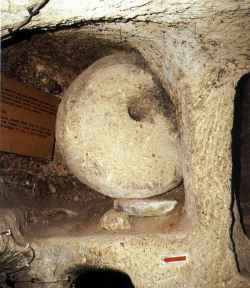
Some authorities suggest that the underground cities were created during the earlier period, as storage areas, by the Hittites and were much later extended and brought into use as refuges for Christians persecuted by the Romans. Others maintain that the cities were created somewhat later, by the Phrygians, as a line of defense against the Assyrians. The most commonly held view is that the cities were excavated during Roman and/or Byzantine times. Certainly during these years the region was often beset by internal strife in the form of persecutions of (and by) local Christian communities, and external attacks by the Arabs. After the region was incorporated into the Ottoman Empire, in the 14th Century, the external threat abated, the Byzantines were forced to leave the area and, with the outbreak of peace, the abandonment of the underground cities began. It is unlikely that the underground cities were ever intended as permanent, or even long stay, settlements, but they were clearly built to withstand attack and could support large numbers of people and their domestic animals, for long periods of time. The urban organization was very complex, and there was probably always work in progress. Extensive networks of passages, tunnels, stepped pits and inclined corridors link family rooms and communal spaces where people would meet, work and worship. The cities were complete with wells, chimneys for air circulation, niches for oil lamps, stores, water tanks, stables and areas where the dead could be placed until such time as conditions on the surface would allow their proper disposal. Most importantly, carefully balanced moving stone doors, resembling mill stones, were devised to quickly block the corridors in the event of an attack. Of course, these doors operated from one side only! Cappadocia`s subterranean way of life is not all history. Around Göreme subterranean canals are still used for water regulation on the terraced farmland. In the villages of Zelve, Soganlı, and elsewhere. there are still some semi-subterranean rooms in use. The underground storage of produce is common practice particularly around Ortahisar where large quantities of locally grown potatoes and citrus fruits brought from the South coast are stored. The underground sites are particularly useful for storage because, while the outdoor temperature can vary from minus 20° C to nearly 40° C. the internal temperature of the sites remains constant throughout the year at 7° to 15° C (depending on proximity to the air shafts). Several underground cities are open to visitors. The largest of these, at Derinkuyu has 8 levels open to the public, there may be as many as 12 more levels as yet unexcavated. There are about 600 outside doors to the city, hidden in the courtyards of surface dwellings. There is some speculation that Derinkuyu may be linked to another underground city, Kaymaklı, which is 9 kilometers away.
|
|
|
Home |
Turkey I
Cities & Sites
I Hotels I
Blue Cruise
I Tours I
Contact Us |
Search I
Ask for a quote to compare:
Cruises I
Biblical Tours I
Incentive Travel I
Hotels I
Transfers
Copyright © 1995-2016 Turizm.net
All rights reserved.