
|
|
|
| Welcome to Turizm.net! |
CAPPADOCIA / St. Basil the Great
|
|
Unlike Athanasius, Basil was not present at the Council of Nicaea. This was the first council summoned by the Emperor Constantine for the entire oikumene (civilized world), hence it was the First Ecumenical Council. But its authority was really built on the affirmations of its infallible status by later ecumenical councils. In Basil's lifetime, the Arian question was far from over. Let us remember that the Council of Nicaea in 325 was called because an Alexandrian priest named Arius had come up with the teaching that there is one God, the "Utterly Alone One," (Monos monotatos) who existed above all created things, whether spiritual or material. This God made a mediator between Himself and the created world (full of misery due to its inconstancy and change). This mediator, called the Logos, created the world, then became incarnate, leading a perfect life which was to be imitated by humans, and for which the Logos and his followers would receive a reward of eternal glory (but not union with God). Thus, Arius was overly influenced ny the ideas of Plato about the unseemly character of the created world, and reduced Christianity to an ethical religion of following Christ's example. Nicaea was supposed to solve the problem by coming up with an airtight wording about who the Son or Logos was and his relationship with God the Father. The assembled Fathers at Nicaea (representatives of the major centers of Christianity) and the Emperor settled on the term homoousios to patro (of the same substance as the Father) was chosen. As was stated in our last expedition into the Fathers, some people today think that these debates over a few letters was useless, but it was, in fact, critical to the faith in a God who is not a distant uncaring unit, but rather a union of three loving persons, whose love overflow, creating the universe and saving even those who had turned away from God, through the Incarnation of one of the Holy Triad, the Logos or Son. This Logos became a human being, in order to bring us into complete oneness with the Divine Triad and its never-ending joy and love. Through the sacraments we become members of His Body (Baptism) and His Body becomes part of us (Eucharist). Thus we become truly one with God through the Son, and we become adopted children of God, partakers in God's own nature through this adoption. Basil was born around 330 into an aristocratic Christian family which produced a number of saints. He received a splendid education at Neo-Caesarea, Caesarea, Constantinople and Athens (where he befriended his life-long ally St. Gregory of Nazianzus. Although many opportunities were open to him, he chose a monastic life, spending time with various ascetical Christian groups and eventually starting his own community. The accent must be placed on community, because Basil felt that anchorites (hermits) were sometimes too self-serving, and that the truest way to God was through a mix of concentration on prayer and worship with service to one's neighbour, beginning with fellow monks, but branching out from there to all in need. His writings and his disciples would set the foundation for most religious communities in both East and West. His influence on St. Benedict of Nursia was very strong. His life became much more complicated when he arrived in Caesarea as a priest and was elected Archbishop in 370. Cappadocia was literally under siege from pro-Arian bishops. Imperial authorities were leaning towards the Arians as well, and Cappadocia was divided into two provinces, partly with a view to help divide those who held to the teachings of the Council of Nicaea. The new Arian force was considerable more formidable than Arius and his cohorts had ever been. Aetius and his disciple Eunomius were astute logicians and had minds like steel traps. (Significantly there are reports from the period, relating how tedious and detailed Eunomius could get in his preaching.) The argument of the Neo-Arians was simple and syllogistic.
All of this is very logical. Basil and his Cappadocian allies had a very stinging response, however. A paraphrase of it might sound something like this: Everything hinges on the proposition that the essence of God is to be unbegotten. Since when do you know the essence of God, smartypants? To know the essence of God would make you equal to God ( Remember the forbidden fruit and original sin? All that was about grasping at equality with God!) In fact, we cannot know the essence of God, but only his external activities (also called energies, from the Greek word energeiai, meaning works). Thus, apophatic theology was brought to the fore and has remained a hallmark of Eastern Christian approaches to God. Apophatic comes from the Greek word for "not speaking". There are certain divine mysteries which are beyond human reason and human articulation. So, even though we live to know God, there are some things we cannot know about God. This paradox, and the many others like it, which form the basis of Christian dogma are unsavory to those who like neat, linear, cut and dry answers to things. Alas, life is seldom neat, linear or cut and dry. Have you ever had a love-hate relationship with someone? If so, then you probably understand. As anyone can guess, winning an intellectual argument is one thing, but wresting control of the Church from a bunch of heretics who have imperial support is quite another. Basil needed more allies as bishops, so he basically forced his best friend, the melancholy but brilliant Gregory of Nazianzus to become bishop of a one-chariot town called Sasima, and his younger brother Gregory to become bishop of Nyssa. Neither of the two Gregories appreciated the gesture. Basil was the most savvy politically, and did most of the maneuvering, especially in trying to rid the Church of State interference during the reign of the Arian emperor Valens (364-378). He also had to fight a new group of people who didn't like the concept of a Triune God: the Macedonians (supposed followers of Macedonius, bp. of Constantinople who died c. 362). The Macedonians were also known as the Pneumatomachoi (roughly Ghostbusters) who denied the divinity of the Holy Spirit. To some degree the Arian controversy was quelled in the East by the Council of Constantinople in 381 (the Second Ecumenical Council). It would survive in pockets in the East, but esp. the West for a few more centuries, but was never again in a position to threaten the Catholic Orthodox teaching of the broader Church as defined by these two Councils. Basil was a very dynamic bishop, taking care of his flock as he simultaneously fought theological battles of worldwide importance. In his diocese, he worked constantly to aid the sick and the poor, instituting hospitals, hospices, orphanages and schools to train people in the arts and industry, so that they could raise themselves out of poverty, and much more. Some of his sermons on poverty (That second coat in your closet is not yours - it belongs to the poor!) would probably get him expelled from most middle class parishes today. His life as a bishop was most difficult. His health was very bad, and he had vicious enemies in the Church and the government. But when he died on January 1, 379, after a scant nine years as Caesarea's archbishop and metropolitan, he was mourned by Christians, Jews and pagans of the city. His dogmatic works are usually against the Arians. Most important are his Against Eunomius (in three books, 364) and his On the Holy Spirit (375), where he defends the doxology "Glory to the Father with the Son, together with the Holy Spirit." Because he did not want to lose the support of some wishy-washy bishops, Basil never actually came out and said that the Holy Spirit is God, but the implication is clear from this book, and it is drawn out later by his younger brother, Gregory of Nyssa. His exegetical writings include the nine homilies called the Haexaemeron (On the six Days of Creation), Homilies on the Psalms, and a work on the first part of Isaiah. In his biblical exegesis he did not follow the Alexandrian allegorical approach, but rather tried to stick with the literal meaning. His ascetical works include three treatises known as The Ascetica, The Moralia, composed of 80 instructions on Christian living, two monastic rules , the Longer Rule and the Shorter Rule, in question and answer format, as well as other works. He also wrote homilies (over twenty are still extant and considered authentic) and a multitude of letters. In the Byzantine and Coptic traditions, there is a Liturgy of St. Basil, (with an anaphora or extended Eucharistic prayer that bears some influence from Basil). Prayer of St. Basil the Great
|
|
Home |
Turkey I
Cities & Sites
I Hotels I
Blue Cruise
I Tours I
Contact Us |
Search I
Ask for a quote to compare:
Cruises I
Biblical Tours I
Incentive Travel I
Hotels I
Transfers
Copyright © 1995-2016 Turizm.net
All rights reserved.
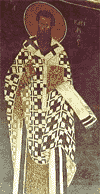 A
younger contemporary of St. Athanasius of Alexandria, St. Basil
the Great (ca.330-379) Archbishop of Caesarea in Cappadocia. The
oldest of the three Cappadocian Fathers, St. Basil's life is
also very closely tied with a vehement defense of the First Ecumenical
Council, held in Nicaea in 325. Basil was too young to have dealt with
Arius. His battle, and that of the other two great Cappadocians, St. Gregory
the Theologian (of Nazianzus) and St. Gregory of Nyssa) was
especially against the later Neo-Arian movement headed by Aetius
of Antioch and later Eunomius of Cyzicus, but it also
necessitated taking very tricky political steps in order not to ruffle the
feathers of a number of mediocre bishops in Asia Minor who were mostly
interested in the status quo, which - at the time - meant confusion in
trinitarian discourse.
A
younger contemporary of St. Athanasius of Alexandria, St. Basil
the Great (ca.330-379) Archbishop of Caesarea in Cappadocia. The
oldest of the three Cappadocian Fathers, St. Basil's life is
also very closely tied with a vehement defense of the First Ecumenical
Council, held in Nicaea in 325. Basil was too young to have dealt with
Arius. His battle, and that of the other two great Cappadocians, St. Gregory
the Theologian (of Nazianzus) and St. Gregory of Nyssa) was
especially against the later Neo-Arian movement headed by Aetius
of Antioch and later Eunomius of Cyzicus, but it also
necessitated taking very tricky political steps in order not to ruffle the
feathers of a number of mediocre bishops in Asia Minor who were mostly
interested in the status quo, which - at the time - meant confusion in
trinitarian discourse.