
|
|
|
| Welcome to Turizm.net! |
CAPPADOCIA / Mevlana
|
|
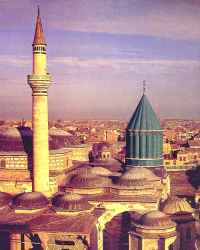 Mevlâna
Celaleddin-i Rumî and the Mevlevi Order Mevlâna
Celaleddin-i Rumî and the Mevlevi Order
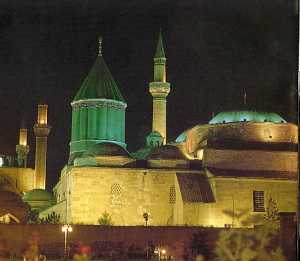
The followers of Mevlâna Celaleddin-i Rumî, belonging a variety of creeds, sects and classes, acknowledged him as their spiritual leader; but during his lifetime ,they had no tekkes nor any fixed rules. It was Mevlâna's son Sultan Veled (1226-1312) who after his father's death in 1273 strengthened and consolidated the order and established a ritual with precise rules which laid great stress on dancing (semâ). The Seljuk Emir Alamüddin Keyser (d. 1284) built a Türbe (tomb) for Mevlâna, so that his adherents had a meeting place and pilgrimage centre, and Sultan Veled provided for the maintenance of the türbe by pious donations. From Konya he sent khalifs to Kırşehir and Erzincan to establish zaviyes and thus bring the believers together in small local centres dependent on the main centre. In later centuries tekkes of the Mevlevi order were directed by çelebi (noblemen) descended from Mevlâna. The order took its final form during the first half of the century. The çelebi frequently played a part in political affairs, a circumstance which on occasion led to differences of view about the use of the community's funds. The Mevlevi doctrine was based on music, dancing and poetry. With its stress on the value of love and ecstasy, it was considered superior to other schools on account of the aesthetic pleasures it afforded. The order acquired adherents among the mass of the people and in the villages, but after the 16th century its main support was among the upper classes in the towns. The emirs, high dignitaries and the Sultans themselves belonged to the order, together with the more prosperous members of society, who in the end made up the whole of its membership. There were four grades in the order - mühib, dede, sheikh and khalif (caliph). The Mevlevi order had a very considerable influence on Turkish literature, music and art, as well as on everyday life. With a membership recruited mainly among the urban middle and upper classes - in contrast to the Batinite order - it played a large part in maintaining the existing social and political structure. The Gülseniye order was strongly influenced by Mevlevi doctrines. Its founder, Hüsamüddin Çelebi of Konya, was the son of a Turkish Ahi. Mevlâna Celaleddin-i Rumî was the first great mystical thinker, scientist and artist of 13th century Seljuk Anatolia. He was born on 30th September 1207 at Balkh, the first capital of the ancient Turkish territory of Khorasan. His father, Bahaeddin Veled bin Hüseyin Hatibî, known as Sultanül Ulema ("sultan of the men of learning"), was descended from a cultivated family of Balkh. According to some of the written sources Bahaeddin's mother was a sister of Sultan Harezmashah Alaüddin Muhammed.
Bahaeddin Veled later fell into disfavour and was obliged to leave Balkh in 1212-13, when Celaleddin Muhammed was only five years old: this at any rate is what we are told in Bahaeddin's work Maarif. In fact the reason for his move was the Mongol invasion; for during a visit to Baghdad in 1217 he learned that the Mongols had laid siege to Balkh. According to a traditional story the father and son conversed with Sheikh Feridüddin Attar (d. 1221), who presented the young Mevlâna with his poem, the Asrarnâme. Bahaeddin Veled thereupon made his way from the Hejaz to Anatolia by way of Damascus. We do not know in what towns he first stayed, but it is known that before settling at Konya he spent seven years at Laranda (now Karaman). It was there that Mevlâna married Gevher Hatun, daughter of Sheikh Semerkandi, and that his son Sultan Veled was born in 1226. In the same year Bahaeddin went to Konya on the invitation of Sultan Alaeddin Keykubad I. Here he enjoyed great renown, the emirs and the Sultan himself coming to listen to his sermons. The Sultan's preceptor Badruddin Gavhartash Dizdar built the Hüdavendigar Medrese for him: a clear indication of the status and admiration he enjoyed among his contemporaries. His only writings were the Maarif, a four-volume work on Koranic mysticism. When Mevlâna Celaleddin was born in 1207 his father was sixty years old. Bahaeddin was a great mystic who had attained the highest degree in the spontaneous and sincere union of the soul with the essence of its being, had arrived at a direct understanding of the soul and the absolute Being, and had found immortality in the existence of God. Mevlâna's philosophy thus derives from the thinking of his father, for whom he felt respect, love and boundless trust. Eflaki tells us that he reread the Maarif several times in order to find the solution to his own problems. We also learn from Mevlâna's own prose work, the Fihi ma Fih, that in his discussions he was accustomed to repeat his father's words. Indeed on one occasion Şems-i Tebrizî urged him not to read the Maarif, which he maintained was influencing his thinking too strongly. The Maarif teaches that mysticism is the achievement of knowledge, ecstasy and love, and not a purely imaginary union. Unlike other mystics, Mevlâna laid stress on love and fervour. In him, as in his father, we observe a transition from spiritual union to the union of humanity, so that the sentiment of divine love gives rise to feelings of tolerance and love for all mankind. Soon after his father's death, in 1231, Mevlâna made the acquaintance of Burhaneddin Termizî and remained for nine years a disciple of this spiritual guide, who was also a great scholar familiar with all the learning of his day. Seyyid Burhaneddin Termizî discoursed to him of the "inward" or "spiritual" state of his father Sultanül Ulema and urged him to attain it. He taught that without this inward being life had no meaning: this alone was the truth of the human heart. Immortality and the perfection of the soul were two quite different things; to attain the immortality of the soul it was necessary to achieve this inward completeness. Burhaneddin Termizî also spoke of the "aesthetic state" which he himself had learned from Sultanül Ulema; and although he explained that this state was not attainable through mere learning but must be sought by giving up the whole soul to the pursuit, Mevlâna nevertheless set out for Aleppo and Damascus to perfect his knowledge of the sciences. It is recorded that at Damascus he made the acquaintance of İbn Arabi; and this seems on the face of it quite likely, for we know that İbn Arabi had left Konya and gone to Damascus, where he lived until his death in 1236, and Mevlâna's stay in Damascus in 1232 would fall within this period. It must be said, however, that there is no mention of this stay in the Velednâme of Sultan Veled, Mevlâna's son. Eflaki tells us that Mevlâna studied jurisprudence and the learning of the sects with the great scholar and poet Kemaleddin Adem, director of the Halaviyye University in Damascus. We also learn from Eflaki that, after his period of association with Mevlâna, Seyyid Burhaneddin Termizî went to Kayseri, where he died in 1240. After his death Mevlâna spent five years teaching jurisprudence and Koranic science at the university; but the mystical truths which he had acquired during his nine years with Burhaneddin had prepared him for a great spiritual adventure. In 1244- he met Şems-i Tebrizî at Konya and fell in love with him, in the mystical sense of the term. This love inspired powerful poetic and mystical impulses which led him to give up his duties as a preacher, a mufti arid a teacher of the sciences, to abandon asceticism and abstinence - to give up, indeed, the whole of his life-in order to acquire a new personality, the personality of a lover in ecstasy. What manner of man was Şems-i Tebrizî, who was able to change so quickly and so easily a man of such strong personality as Mevlâna? This has been the subject of much discussion, and a variety of very different views have been put forward, both in earlier and in more recent times. Mevlâna himself went so far as to divinise his master, in the mystical sense of the term, using the form of address "My Şems, my God". Sultan Veled, Mevlâna's son, who knew Şems-i Tebrizî well, explained the relationship between the two men in the following way, in an attempt to enlighten those who might seek to judge the matter on the basis of appearances: "As soon as he saw Şems's face the mysteries were revealed to him like the light of day. He saw what no man had ever imagined. He fell in love and was lost: greatness and baseness were alike indifferent to him." The following words throw a revealing light on the character and personality of Şems-i Tebrizî: "There is a world above the world of saints (evliya): the world of the ‘adored ones' (makam-ı maşuk). Before Şems-i Tebrizî we knew nothing of this. And so Şems is one of those who in the eyes of ordinary people are even more secret and incomprehensible than the mystics: that is, the lovers. It was he who showed the way to Mevlâna; and Mevlâna said that he needed to re-learn everything after meeting Şems." Eflaki tells us in his Menakibül Arifin that during this period of his life, on the suggestion of Şems, Mevlâna began to practise and teach the Semâ. The Semâ
ın 1245 Şems fled to Damascus to escape the jealousy Mevlâna's disciples, but on the urgent plea of Mevlâna, who could not endure this separation, he returned to Konya, accompanied by Sultan Veled, and married Mevlâna's adopted daughter Kimya Hatun. Thereupon a group of Mevlâna's disciples, including his second son Alaeddin Çelebi, again began to conspire against Şems, of whom they were jealous; and this was followed by the mysterious disappearance of Şems in 1247. Mevlâna fell into the deepest despair and made two journeys to Damascus in search of Şems. Sultan Veled tells us that the words and actions of his father made a strange impression on the people of Damascus, although Eflaki declares that he acquired many followers there. After the final disappearance of Şems Mevlâna alternated between hope and despair, and gave himself up to the Semâ with such passion that his son Sultan Veled, although devoted to his father, felt bound to make a courteous protest. He danced everywhere - in the streets, in the convent, in the medrese. Finally, after long questing, Mevlâna found Şems again within himself: that is, like certain mystics and like his own father, he began to be dominated by the idea and the state of identification with the adored being. In other words Mevlâna had a wholehearted faith in the uniqueness of God and, having lost the absolute love which he had found in Şems, found it again after a long period of seeking – first within himself, and then everywhere and in all things. He was able at last, as he himself expressed it, to free himself from "colours and images" and to attain the world of a single colour: that is, the union of the soul and the spirit. The influence of Şems also explains Mevlâna's passion for the Semâ, for music and poetry. In his own poems - the Divan-ı Şemsu'l Hakayik, devoted to immortalising Şems - he achieves the loftiest expression of pantheism, under the impulse of fervent love and a sublime and divine inspiration. At the same time they are a record of his feelings, his inner conflicts and his mystical flights. In order to trace the full extent of the spiritual influence wich Şems exerted on Mevlâna, however, it is necessary to compare Mevlâna's writings with the Makalât, which contains the teachings of Şems. There are passages in Mevlâna's Mesnevi, indeed, which are explicitily borrowed from the Makalât. In 1257 Mevlâna met another man who took Şems's place in his heart. This was Salahüddin, a jeweller of Konya: a handsome, simple-minded, prudent and devout man, who was able by his persuasiveness and shrewdness to calm Mevlâna and give him back peace of mind. Mevlâna appointed him as his khalif and married his son Sultan Veled to Salahüddin's daughter Fatma Hatun so that they should be joined by the bonds of kinship. Salahüddin himself had a profound respect for Mevlâna's master Burhaneddin and also for Şems-i Tebrizî. Mevlâna's jealous disciples now threatened Salahüddin with death; but Salahüddin met them with these words: "How can you put an end to my life, which is in God's hands? Do not be angry that Mevlâna has chosen me as his companion, for I am merely the mirror. Mevlâna sees himself in me: how, then, should he not choose himself? What he loves in me is his own beauty." The MesneviMevlâna wrote 71 ghazels (poems) to Salahüddin, who died in 1262; and in his letters he refers to him as "the Beyezit of his time, the pole of poles." After his death Hüsamüddin Çelebi of Urumiye became Mevlâna's khalif and companion. But now Mevlâna's spirit, which had been growing calmer, was moved by fresh impulses, and this recrudescence of Agitation produced the Mesnevi. On the plea that mystical and didactic works like the Ilahinâme and the Mantik ut-Tayr of Sheikh Feridüddin Attar enjoyed great favour among the dervishes, Hüsamüddin Çelebi begged his sheikh to write a Mesnevi which should instruct the adept on the rules of the order and the mystical realities. Mevlâna thereupon pulled out of the folds of his turban a piece of paper with eighteen lines written on it, saying that he had already been thinking of this. On this basis they began to compose the Mesnevi, Mevlâna dictating and Hüsamüddin Çelebi writing down the inspirations and thoughts of his sheikh. When the first volume was complete Hüsamüddin's wife died and the work of composition came to a halt for two years. Later, on the plea of Hüsamüddin, work was resumed and the six volumes of the Mesnevi, with 26,000 lines, were completed. The whole work took seven or eight years: neither the exact date of beginning or ending is known, but the second volume gives 1264 as the date of beginning the work. Towards the end of the first volume it is stated that the Abbasids were ruling at Baghdad during its writing, indicating that the first volume must have been written in 1258. The Mesnevi, one of the masterpieces of Islamic mystical literature, is a moral and didactic work written mainly for adepts and disciples. It largely follows the pattern of Attar and Senai (d. 1131) in expressing ideas, precepts and opinions in the form of parables. The course of the main story is interrupted by the insertion of other tales but is then resumed and completed after the interruption. Mevlâna was no formalist, and in this work, unlike the Divan-ı Kebir, he uses verse solely for its educative value. This time there was no opposition to Mevlâna's friendship with his disciple, and after his death on 17th December 1273, on the urgent insistence of Sultan Veled, Hüsamüddin Çelebi agreed to become khalif. Mevlâna's death, which took place at Konya after a short illness, was seen as one of the most important events of the period. Men of all countries, classes and religions followed his funeral cortege and watched night and day over his tomb. The event is described in Ahmed Eflaki's Menakib in these words: "In him the Christians mourned their Jesus, the Jews their Moses." A priest expressed the need all men felt for him: "Mevlâna is like bread: what man shall think of turning away from him?" Mevlâna's true greatness lay in the fact that, whereas the various religions and sects have a force within them making for separation, he brought all religions and sects together in the melting-pot of love, giving fresh life to dead and desiccated spirits in a veritable resurrection of the human soul. In the Fihi ma Fih, a collection of Mevlâna's sayings put together by his son Sultan Veled or one of his disciples, we find an expression of his mystical conception of death: "Do not blame death and illness for me, for death exists merely to conceal the truth: what in reality kills is the matchless grace of God." In the same work we find his conception of the afterlife in the religious sense: a spiritual world beyond the terrestrial world, whose transitory pleasures do not satisfy; a world which man himself loves and creates by his struggles, in which he will find peace and serenity. Mevlâna had two sons by his first wife Gevher Hatun, Sultan Veled and Alaeddin Çelebi. By Kena Hatun, whom he married after the death of his first wife, he had Muzaffuruddin Alim Çelebi and Melik Hatun. Of all these children the one who most resembled his father was Bahaeddin Veled (1226-1312). He had, therefore, been brought up with great care, and Mevlâna's father, Sultanül Ulema Bahaeddin Veled, handed on his own name to his grandson. In 1284, after the death of Hüsamüddin Çelebi, Sultan Veled was appointed khalif on the urgent insistence of the adepts, and occupied this position until his death in 1312. During this period he wrote his work-s and sought to establish the Mevlevi order on a systematic basis, adding new rules and new methods to the structure of which his father had laid the foundations. Mevlâna, the Mystical PhilosopherAfter this account of Mevlâna's life, work and ideas as they emerge from his own writings it seems necessary to attempt a definition of his mystical and spiritual personality. Mevlâna was not a philosopher: he was a mystic. But since mysticism is basically a philosophical theory he can perhaps be described as a mystical philosopher. At the same time he was a moralist and an acute psychologist, with a profound understanding of men in all their aspects, individually and in society; a man who exercised great influence on others, and, a very great poet into the bargain. Mevlâna disagreed with the philosophers-because they valued only reason. in his view it was necessary to have regard to men's feelings as well. Man is always yearning for the. ineffable, and Mevlâna, attaching more importance to feeling than to reason, believed that the only approach to absolute Being was through the heart and by a synthesis between the outward and the inward worlds. The outward world, he taught, is merely the foam on the surface of the sea: the inward world is the infinite sea itself, invisible and perceptible only through the heart. For Mevlâna, basing himself on reason in everyday life but on feeling as a means of attaining mystical truths, the way of the heart is love. The only way to attain absolute Being is by love; the absolute Being is God, the love of God is to be found everywhere, and everything leads to God. If we love everything for God's sake and if this love leads us towards God, we shall find God at the end of the way. The main thing is to love, to have the capacity to be in love. Mevlâna believes that the human soul can become united with the infinite and identify itself with the infinite by annulling its own substance and following the way of the heart. God is absolute truth, absolute beauty and absolute light. The mystic who succeeds in annihilating his own being and drowning himself in ecstasy can attain understanding and knowledge. Mevlâna attaches great importance to Semâ because the pleasure and enthusiasm obtained from Semâ, morally exalted and purely aesthetic, take man away from the material world. Semâ is the unitary soul which dances round the integral soul as the moth flutters round the candle, singeing its wings. The universe emanates from a single Being, who is God. All forces and all things are merely manifestations of God in diverse forms. In this Being there is Union, and Mevlâna believes that all religions are basically one. In the field of morality the principles to which he attaches greatest importance are those which procure serenity for the individual and the people with whom he comes into contact - morally edifying qualities like modesty, patience, resignation, abnegation, kindness and honesty. He taught his disciples to avoid any discrimination on grounds of colour, race, class, wealth or strength, to love and respect all men, since each man was a reflection of the absolute Being. This is perhaps the main difference between his mystical thought and that of other mystics. In no other religion or sect are the love of mankind and the idea of tolerance expressed with such lucidity and purity. By his invocation, "Come; let all men come!" he calls on all humanity to follow his way and imposes on himself the duty to educate and sublimate mankind. He is thus an educator as well as a philosopher. The full greatness of Mevlâna Celaleddin-i Rumî is revealed in his works and in the doctrines of the Mevlevi order, which so profoundly influenced the artistic and intellectual life of the Turkish people: a sage, a mystical philosopher, a thinker and a poet, whose achievement forms part of the spiritual heritage of all mankind.. "Come, come" whoever you are;
|
|
Home |
Turkey I
Cities & Sites
I Hotels I
Blue Cruise
I Tours I
Contact Us |
Search I
Ask for a quote to compare:
Cruises I
Biblical Tours I
Incentive Travel I
Hotels I
Transfers
Copyright © 1995-2016 Turizm.net
All rights reserved.
 He
was much concerned with religion and mysticism: in the morning he taught
theology in the medrese, in the afternoon he discoursed on the
truths and mysteries of life, and on Fridays he devoted his whole time to
sermons. It is recorded that he openly propagated his ideas and
conceptions, which were mainly of a mystical cast. Ahmed Eflaki, author of
the Menakibül Arifin ("Legends of the Sages"),
tells us that Bahaeddin Veled was in disagreement with Fahreddin Razi (d.
1209), master of Muhammed Harezmashah and one of the leading philosophers
of the day.
He
was much concerned with religion and mysticism: in the morning he taught
theology in the medrese, in the afternoon he discoursed on the
truths and mysteries of life, and on Fridays he devoted his whole time to
sermons. It is recorded that he openly propagated his ideas and
conceptions, which were mainly of a mystical cast. Ahmed Eflaki, author of
the Menakibül Arifin ("Legends of the Sages"),
tells us that Bahaeddin Veled was in disagreement with Fahreddin Razi (d.
1209), master of Muhammed Harezmashah and one of the leading philosophers
of the day.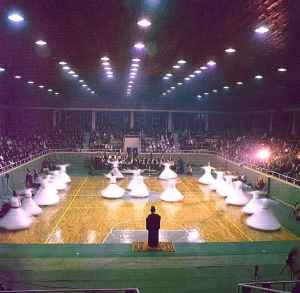 Semâ
means to whirl round, to dance, to attain ecstasy by means of music. Many
mystics, according the needs of their soul, practised the Semâ as a
source of ecstasy. Mevlâna regarded it as a kind of prayer, a form of
worship, comparing a man who sang during the Semâ to the imam officiating
at the namaz (prayer). In his poems he calls the Semâ the
nourishment of lovers' souls; it was an activity permitted to lovers and
mystics but forbidden to bigots.
Semâ
means to whirl round, to dance, to attain ecstasy by means of music. Many
mystics, according the needs of their soul, practised the Semâ as a
source of ecstasy. Mevlâna regarded it as a kind of prayer, a form of
worship, comparing a man who sang during the Semâ to the imam officiating
at the namaz (prayer). In his poems he calls the Semâ the
nourishment of lovers' souls; it was an activity permitted to lovers and
mystics but forbidden to bigots.