
|
|
|
| Welcome to Turizm.net! |
CAPPADOCIA / Haci Bektas
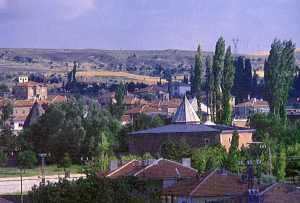 Hacıbektaş
46 km from the city of Nevşehir might look at first sight no different
from any other central Anatolian town. Indeed, if you are driving from
Ankara, in your eagerness to see Cappadocia, the Ihlara Valley and the
underground cities, you might easily pass through Hacıbektaş
without even realising. But if you halt here before continuing on to
Avanos, and spare an hour or so to visit the dervish dergâh (lodge) in
the centre of the town, you will be able to make the acquaintance of the
Alevi order, one of the heterodox branches of Islam. Hacıbektaş
46 km from the city of Nevşehir might look at first sight no different
from any other central Anatolian town. Indeed, if you are driving from
Ankara, in your eagerness to see Cappadocia, the Ihlara Valley and the
underground cities, you might easily pass through Hacıbektaş
without even realising. But if you halt here before continuing on to
Avanos, and spare an hour or so to visit the dervish dergâh (lodge) in
the centre of the town, you will be able to make the acquaintance of the
Alevi order, one of the heterodox branches of Islam.
These teachings, which came to be known as Bektaşi, address the heart, and urge friendship and humility instead of strife. Much later his teachings were given systematic form by the 15th-16th century Bektaşi dervish Balım Sultan, and so the Bektaşi dervish order gained its body of tradition over the centuries. The dergâh or dervish lodge of Hacıbektaş became a museum in 1964. The entrance leads into a large courtyard, to the right of which once stood buildings accommodating the dervishes who worked the land and farm labourers employed by the lodge. These buildings were demolished when the lodge was being converted into a museum, and a wall built here. At the far end of the wall is the Üçler Fountain symbolising the Creator, Muhammed and Ali, a fundamental concept of Alevi faith. An open space on the left is like a small park, and originally there were stables for the horses of guests, barns and other outbuildings here. At the end of the courtyard a gate leads into a second courtyard, where there is a pool with a border of flowers. If it is not too crowded you can drink from the holy water of the Lion Fountain. The inscription over this fountain explains that the lion statue was brought from Egypt as a gift to the lodge in 1853. The second courtyard was the busiest part of the lodge, with the aşevi (refectory), pantry, hamam (baths), guest house, hall where the sacred services known as cem were held, and the pavilion where the lodge’s leader, the Dedebaba, received guests. The final gateway leads into the third courtyard where the tomb of Hacı Bektaş Veli stands. On the right are the graves of dervishes belonging to the lodge, and in the small mausoleum just beyond lie Balım Sultan and Kalender Şah, two great figures of the order. The ancient wishing tree in front of the mausoleum is one of the places which visitors never fail to stop at. Before entering the mausoleum it is customary for visitors to embrace the cylindrical marble stone in the right-hand corner. If you can embrace it with two arms, then it is regarded as proof that your heart is clean and your intentions pure. The tomb was built by Şeyhsuvar Ali, lord of the Dulkadirogulları principality, in 1519 following the death of Balım Sultan. The walls of the mausoleum are decorated with painted kalem işi, and there are examples of Bektaşi calligrapher. The door is original. The mausoleum of Hacı Bektaş Veli himself is known as Pir Evi, and at the entrance are the graves of the baba’s of the order, dervishes who attained the highest degree. As you walk towards the Kırklar Meydanı hall, on the right you pass the çilehane, a cell where the dervishes spent time alone in the presence of God. If you wish to see inside you must bend almost double, and a few minutes alone in that dark cell gives you an impression at least of what it must have been like for the dervishes who came here. On the raised platform to the left of the Kırklar Meydanı are buried the descendants of Hacı Bektaş who sat on the ceremonial fleece of office and were known as çelebi or bel evlatları. In this hall where the dervishes performed the ceremonial dance known as the kırklar semahı, are now exhibited the twelve sided stones known as teslim taşı which the dervishes hung around their necks as symbols of the Bektaşi order, earrings worn by unmarried dervishes who devoted their lives to serving their lodge, handwriting of the Caliph Ali on gazelle skin, beautiful examples of calligraphy, torches, censers, and the Kırkbudak Candelabra which according to the Velayetname came from India. Finally a small door on the right leads into the tomb chamber of Hacı Bektaş Veli, where visitors perambulate three times around the sarcophagus before offering up a supplication to Hacı Bektaş Veli. Near the lodge is Dedebagı, an open park scattered with trees, where visitors who have come for the commemoration ceremonies gather to picnic and drink the ice cold spring water from a fountain known as Şekerpınar. Another important holy place is the Çilehane, a cave where Hacı Bektaş Veli spent forty days and nights alone in prayer to God. A narrow entrance leads into the cave, inside which is an aperture through which it is said that those who manage to pass have pure hearts, so many people can be seen attempting to do it. But it is quite a feat, not to be recommended for people with high blood pressure or heart complaints. Every evening in the amphitheatre next to the Çilehane you can listen to musicians playing wonderful traditional folk music and watch theatre plays. Monuments to the 16th century poet Pir Sultan Abdal and 14th century poet Yunus Emre are also near here. The town of Hacıbektaş continues to be a fount of the mystic concept which sees God in man, and it is this idea which brings people who believe in peace between men and forbearance towards others flocking here from all over the world. |
|
|
Home |
Turkey I
Cities & Sites
I Hotels I
Blue Cruise
I Tours I
Contact Us |
Search I
Ask for a quote to compare:
Cruises I
Biblical Tours I
Incentive Travel I
Hotels I
Transfers
Copyright © 1995-2016 Turizm.net
All rights reserved.
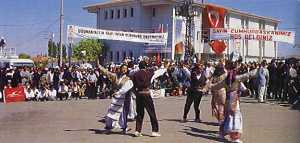 If
your visit is timed for august, you will be able to watch the
international commemoration ceremonies, and get an idea of the living
traditions of the order’s followers. Hacıbektaş is the sacred centre
of Alevi Islam, and every year on 16, 17
and 18 August, tens of thousands of people flock here,
not just from Turkey, but from Bulgaria, Albania and other Balkan
countries.
If
your visit is timed for august, you will be able to watch the
international commemoration ceremonies, and get an idea of the living
traditions of the order’s followers. Hacıbektaş is the sacred centre
of Alevi Islam, and every year on 16, 17
and 18 August, tens of thousands of people flock here,
not just from Turkey, but from Bulgaria, Albania and other Balkan
countries.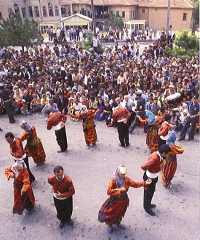 They
come from communities which follow the teachings of Hacı Bektaş Veli,
whose emphasis on peace and tolerance make his a universally relevant
doctrine still widely popular today. During the three days of the
ceremonies, people from far and wide: from the Deliorman villages of
Bulgaria, Albania, and the Turkish provinces of Isparta, Tokat, Tunceli,
Mersin, Antalya, and Erzincan come together here. Teams of Alevi semah
dancers from different regions and in colourful costumes perform these
ceremonial dances, each of which represents a separate thread in the rich
cultural tapestry. The last representatives of the folk ministrel
tradition take the stage, sharing it with modern-day theatre companies and
music groups. Book and souvenir stands are set up, and for three days the
small town is transformed by the festival mood. The life of Hacı Bektaş
Veli is shrouded in mystery. All that is known are stories and legends
passed down by word of mouth until they were written down several
centuries after his death in a book entitled the Velayetname by a
Bektaşi dervish. It is believed that Hacı Bektaş was descended from the
Caliph Ali (Alevi means those who follow in the footsteps
of Ali), and his date of birth is given variously as 1209 and 1247. The
Velayetname tells us that Hacı Bektaş came from Nishapur in Turkistan,
where he was the student of Lokman Perende, one of the followers
of Ahmed Yesevi. He later migrated to Anatolia, where he settled
in Sulucakarahöyük and began to spread the teachings of the Alevi mystic
tradition in Turkey.
They
come from communities which follow the teachings of Hacı Bektaş Veli,
whose emphasis on peace and tolerance make his a universally relevant
doctrine still widely popular today. During the three days of the
ceremonies, people from far and wide: from the Deliorman villages of
Bulgaria, Albania, and the Turkish provinces of Isparta, Tokat, Tunceli,
Mersin, Antalya, and Erzincan come together here. Teams of Alevi semah
dancers from different regions and in colourful costumes perform these
ceremonial dances, each of which represents a separate thread in the rich
cultural tapestry. The last representatives of the folk ministrel
tradition take the stage, sharing it with modern-day theatre companies and
music groups. Book and souvenir stands are set up, and for three days the
small town is transformed by the festival mood. The life of Hacı Bektaş
Veli is shrouded in mystery. All that is known are stories and legends
passed down by word of mouth until they were written down several
centuries after his death in a book entitled the Velayetname by a
Bektaşi dervish. It is believed that Hacı Bektaş was descended from the
Caliph Ali (Alevi means those who follow in the footsteps
of Ali), and his date of birth is given variously as 1209 and 1247. The
Velayetname tells us that Hacı Bektaş came from Nishapur in Turkistan,
where he was the student of Lokman Perende, one of the followers
of Ahmed Yesevi. He later migrated to Anatolia, where he settled
in Sulucakarahöyük and began to spread the teachings of the Alevi mystic
tradition in Turkey.