
|
|
|
| Welcome to Turizm.net! |
CAPPADOCIA / Gülşehir
|
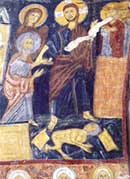
The most outstanding historical monument in the town is the Külliye built by Kara Vezir Paşa in 1779 in the Ottoman Baroque style. It consists of a mosque, a medrese and fountain. ÇAT VALLEYÇat, to the north-east of Nevşehir, is another valley famous for its rock-cut caves and stone houses which were built in the last century. AÇIKSARAY15 km outside Nevşehir, on the Nevşehir-Gülşehir road (route 765), you will come across a deserted cave-village with rock-cut dwellings and chapels, to which the local inhabitants have quite recently given the name Açıksaray (Open Palace). The village is remarkable for its facades and the weird-looking formations, some resembling huge mushrooms, trees, even human faces. This small settlement can be dated back to the 10th or 11th centuries. It covers an area of one square kilometer and contains eight complexes gathered around three-sided courtyards, each with a decorated main facade. The first complex on the right when you enter Açıksaray from the Nevşehir-Gülşehir road has an elaborate facade one of the best in Cappadocia. The complex has two irregular rooms and one rectangular, in which a large equal-armed cross is carved on the interior wall above the entrance. Their heads are lost, because a window-like opening has been cut on the wall. The motif of the bull, which is regarded as sacred by the Neolithic communities in Anatolia and the Hittites, can only be seen in Açıksaray. THE CHURCH OF St. JOHN (Karşı Kilise)The Church of St. John is at the time of writing being restored, with beautiful frescoes appearing as its blackened walls are cleaned. Check with Nevşehir tourist information office to find out whether the church has yet been opened to visitors. HACI BEKTAŞÖZKONAKThe underground city was discovered in 1972 by muezzin Latif Acar, who was trying to find out where the water disappeared to when he watered his crops. He discovered an underground room which, later excavation revealed, belonged to a city with ten floors up to a depth of 40m. At present only four floors are open (up to 15m), but throughout the village can be seen parts of rooms belonging to the first and second levels. These first two levels were used for food storage and wine fermentation, and a press and reservoir are labelled, as are mangers for stabled animals. Another typical feature is the stone doors, moved by wooden levers; above them was a small hole, through which boiling oil would have been poured on an enemy trying to break the soft sand-stone door. BELHABelha monastery is a religious center built around a courtyard in the 6th century. The complex comprises a refectory, a cellar, a kitchen, bedrooms, a large meeting hall, burial chambers, a church and rooms for monks. |
|
|
Home |
Turkey I
Cities & Sites
I Hotels I
Blue Cruise
I Tours I
Contact Us |
Search I
Ask for a quote to compare:
Cruises I
Biblical Tours I
Incentive Travel I
Hotels I
Transfers
Copyright © 1995-2016 Turizm.net
All rights reserved.
 Gülşehir
is a lovely town, once inhabited by the Hittites and the Romans, known as
Zoropassos during the Persian epoch and Arapsun before the Ottoman
conquest, the town flourished under the patronage of Seyit Mehmet Paşa,
better known as Kara Vezir (Black Vizier), who was born in Gülşehir and
became a minister of state in İstanbul.
Gülşehir
is a lovely town, once inhabited by the Hittites and the Romans, known as
Zoropassos during the Persian epoch and Arapsun before the Ottoman
conquest, the town flourished under the patronage of Seyit Mehmet Paşa,
better known as Kara Vezir (Black Vizier), who was born in Gülşehir and
became a minister of state in İstanbul.