
|
|
|
| Welcome to Turizm.net! |
CAPPADOCIA / Folk Music and Dancing
 Writing
in Ülkü magazine in the 1940s, Ahmet Adnan Saygun said, ‘There is no
difference between excavating the ground to reveal an ancient monument and
compiling folk traditions or folk music. In order to arrive at broad
conclusions neither the one nor the other should be neglected’. Writing
in Ülkü magazine in the 1940s, Ahmet Adnan Saygun said, ‘There is no
difference between excavating the ground to reveal an ancient monument and
compiling folk traditions or folk music. In order to arrive at broad
conclusions neither the one nor the other should be neglected’.
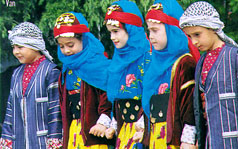
Do the many diverse dances of Turkey today have a common source? Like many of the arts of Anatolia, its folk dances have roots going back far in time. Just as the music of the Phrygian Olympus is regarded as the original source of western classical music, so the sounds and movements of folk dances from many countries are the original spring of today’s modern dances. In folk music and dances we find powerful reflections of the human experience over thousands of years, expressed with a passion unmatched elsewhere. In Anatolia, which has been home to the Hittites, Phrygians, Lydians, Urartians and many more peoples and empires, music, folk dances and folk costumes are the repository of a long and rich cultural legacy. Muzaffer Sarısözen, who devoted much of his life to studying folk dances and their music, used to say that the music and dances themselves are their own historical sources. He observed that striking the knees is the movement most widespread in Turkish folk dances, occurring in many different types, including spoon dances. Often the movement follows agile leaps. In dances of the bar and halay types where the dancers sweep forward and then in an instant drop down and slap their knees, the staccato sound is exhilarating to hear.
In some cases the common threads which run through Turkish folk dances can be attributed to the Central Asian Turkish legacy, and in others to ancient Anatolian pagan rituals whose sacred character has long since been forgotten, but which continue to express a communal exuberance and joy. The origins of some dances probably lie in historic events which came to be dramatised in the abstract forms of dance. Dances which developed at a later date often have clearer origins, representing what must clearly have been real stories of lovers or heros who captured the popular imagination. The Adurrahman Halay of Sivas is an example of the latter, its movements acting out a drama of heroism unrecorded in history. We can discover neither the identity of Abdurrahman nor the time when he lived, quite apart from the details of his story. But perhaps seeking for the derivations of a dance is a futile process which defeats its object. Instead we should recognise that what matters is the meaning inherent in the dance itself, for which the observer is free to create a hero, a story and a conclusion in his own imagination. Of course this requires a good understanding of the symbolic expressions conveyed by music and movements. What messages do the different movements of arms, feet and legs hold? In trying to answer this question, we must remember that these messages may be at the same time abstract and concrete.
The exultation arising from acts of valour is a theme which recurs in many Anatolian dances according to experts. It is unmistakable in the zeybek, dagger, sword and knife dances. In similar fashion, the way in which lines of dancers tightly packed arm-in-arm and shoulder-to-shoulder advance forward is interpreted as symbolising mountain ranges or castle walls. Undoubtedly, they are simultaneously an expression of inner emotions and aesthetic values passed down over successive generations. The Güvende, Sekme and Kalkan (Shield) dances of Bursa, the Halay and Türkmenkızı (Turcoman’s daughter) of Çorum, the Halay of Urfa, the Sepetçioglu and Topal Koşma of Kastamonu, the Bengü of Bergama, the Düz Halay, Kızık Halay, Tanzara, Timuraga, Aşırma, Tikine, Dello, Üç Ayak, and Köy Bicosu of Sivas, and the Sıksara of Trabzon... The list could go on for pages. These colourful dances range from the vigorous to the gently graceful, and their moods from dramatic to romantic. Of particular interest to those seeking out origins of folk dances is the Sinsin, which involves quiet hissing calls, whistles and shouts, and varies according to whether it is performed on moonless or moonlit nights. On moonless nights a large fire is lit in the dancing place, around which the dancers weave tight circles, then let go of their neighbours and perform a whirling chase. This version of the dance is as quiet and stealthy as it is energetic. On moonlit nights no fire is lit, and it is danced to the noise of fife and drum. The name Sinsin comes from the ancient Anatolian and Mesopotamian moon goddess Sin. Thousands of years ago in Babylon worshippers of Sin sang mournful or joyful hymns and danced. The ruins of the great Temple of Sin in Harran in southeast Turkey can be seen today. Although the goddess herself has been forgotten and her temples have fallen to dust, her dance lives on. The term ‘tanrı şenligi’ (‘divine festival’) still used to refer to the halay and horon dances, again suggests an ancient sacred origin. Several types of the Sinsin are still danced in southeast and central Turkey. Another dance thought to have similarly ancient origins is the Türk Halayı of Sivas. The way in which the dancers stoop and writhe with bent shoulders and rub their knees is interpreted as an imitation of people in anxiety and fear. After beating their breasts they bend to the ground as if tilling the soil, and perform movements which are believed to symbolise harvesting and threshing corn, and preparing and eating bread. Finally they turn to the sun god, rising up with the confident strength and happiness of one who has eaten his fill. Links have been postulated between this dance and Sumerian legends found on cuneiform tablets. These allegories tell of the transition from a primitive hunter and gatherer to farmer and pastoralist, and it is as if they are acted out in the actions of the dance, which in some cases includes movements inspired by the domestication of the goat and sheep, the dancers seeming to spin thread from wool and make clothes. The traditional costumes worn by Turkish folk dancers are another fascinating subject of study. For example, the bandits or efe of the Aegean region, who made their homes in the Madran and Kozak mountains, danced the Bengü and Zeybek in their magnificent outfits of long colourful sashes with pads beneath and tobacco pouch and handkerchief tucked into its folds, fringed blue silk shirts with slits in the long sleeves, short cepken jackets, a Tripoli silk scarf wound around their heads, knee-length şalvar, and their armoury of weapons hung about them - yatagan swords in their leather scabbards at their waists, and knives and daggers in their leather holsters. Source : Article – "Turkish Folk Dances" Necdet Sakaoglui, Skylife (the Magazine of Turkish Airlines) December 1998 |
|
|
Home |
Turkey I
Cities & Sites
I Hotels I
Blue Cruise
I Tours I
Contact Us |
Search I
Ask for a quote to compare:
Cruises I
Biblical Tours I
Incentive Travel I
Hotels I
Transfers
Copyright © 1995-2016 Turizm.net
All rights reserved.
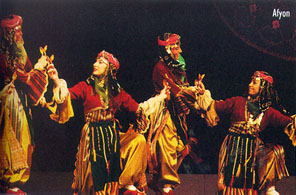 In
the zeybek dances, with their swashbuckling mood of adventure appropriate
to the bandits who performed them, the dancers suddenly strike their knees
with a vigour which sets the heart racing. The famous bar dances of
Erzurum begin with a series of foot and arm movements executed at walking
pace, then the line of dancers leap and crouch before pulling back. This
is repeated at least three times in each bar.
In
the zeybek dances, with their swashbuckling mood of adventure appropriate
to the bandits who performed them, the dancers suddenly strike their knees
with a vigour which sets the heart racing. The famous bar dances of
Erzurum begin with a series of foot and arm movements executed at walking
pace, then the line of dancers leap and crouch before pulling back. This
is repeated at least three times in each bar.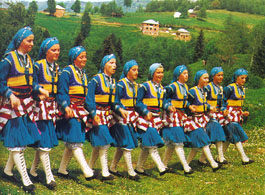 What
for example does the Tavas Zeybegi dance of the Aegean region relate?
According to one theory, it acts out the destruction of the Tavasogulları,
a loser in the struggle waged between rival Turkish principalities in the
Aegean hinterland during the Middle Ages. Whether true or not the idea of
a principality’s former power and splendour being kept alive by the
dance movements and costumes of 20th century dancers is a moving one.
What
for example does the Tavas Zeybegi dance of the Aegean region relate?
According to one theory, it acts out the destruction of the Tavasogulları,
a loser in the struggle waged between rival Turkish principalities in the
Aegean hinterland during the Middle Ages. Whether true or not the idea of
a principality’s former power and splendour being kept alive by the
dance movements and costumes of 20th century dancers is a moving one.