
|
|
|
| Welcome to Turizm.net! |
CAPPADOCIA / DEVOCATES OF CAPPADOCIA
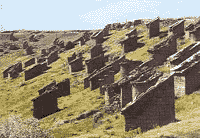 The
fascinating landscape of Cappadocia with its rock hewn churches,
monasteries and underground cities has another feature which few visitors
are aware of. These are the dovecotes carved into the rock pinnacles and
high valley sides. The
fascinating landscape of Cappadocia with its rock hewn churches,
monasteries and underground cities has another feature which few visitors
are aware of. These are the dovecotes carved into the rock pinnacles and
high valley sides.
In ancient Greek mythology the dove represented Aphrodite, goddess of beauty and love, and figures in the holy books of the major monotheistic religions. The earliest reference is in the Old Testament, where Noah releases a dove to seek land, and it returns with an olive branch showing that life had been restored following the deluge. From then on the olive branch and the dove became symbols of friendship and peace. In the New Testament, when Jesus is being baptized, the Holy Ghost alights on his head in the form of a white dove, which is why in Christian iconography the dove represents the Holy Ghost. In the Koran, when Mohammed is fleeing from the Qureysh, he hides in a cave. Spiders weave webs over the entrance and a dove makes her nest, so his pursuers do not bother to look inside and he is saved. In consequence, the generality of Muslims regard pigeons and doves as sacred and do not hunt or eat them. From the same motive buildings in Islam countries often incorporate dovecotes.
Since doves and pigeons need to drink water frequently in order to digest the grains with which they fill their crops, dovecotes were usually built near sources of water, and the birds themselves were regarded as protectors of springs. In Cappadocia the dovecotes carved into the upper parts of cliffs or pinnacles almost always face east or south across the valleys. Most of them date from the late 19th or early 20th century, although there are a few from the 18th century. From the point of view of the art historian they are interesting for the rare examples of Turkish folk painting which usually decorate the façade. Cappadocian dovecotes attracted the attention of western travelers to the region from the 18th century onwards, and there are engravings of them in the travel accounts of Charles Texier and William Hamilton.
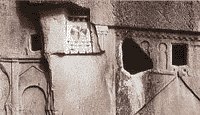
The largest dovecotes in Cappadocia are to be seen in the Üzengi Valley and at Soganlı, where there are sometimes seven or eight dovecotes one above another. In some cases the entrances and windows of Byzantine period rock monasteries or churches were closed up to form dovecotes, the best examples of this type being the Çavuşin (Nicephorus Phocas) and John the Baptist churches near Çavuşin, the Kılıçlar (Kuşluk) Church of the Virgin Mary in Göreme, the Durum Quadra and Yusen Koa churches in the Karşıbucak Valley, and Halloo Monastery in Ortahisar. Free standing dovecotes made of cut stone are also seen in some places. Architecturally no different from the local one or two-story cottages, such dovecotes are common in the Güvercinlik Valley near the town of Uçhisar and in the Üzengi Valley near Ürgüp.
Dovecote façades were usually painted by local artists using pigments obtained from trees, flowers, roots, earth containing ferrous oxide, and a local red earth known as yoşa. Walnut shells and leaves provided four tones of green, buckthorn yellow, raisins dark red, onions pink, pennyroyal tones of grey, and Tussilago farfara and alder bark brown; while cow’s urine lent gloss to the colors. Local people explain that a mixture of plaster and egg white spread on the façades makes it harder for animals like martens, foxes and weasels to get a grip and climb into the dovecotes. But more often tin or zinc sheets have been nailed beneath them to serve the same purpose. In the Soganlı Valley almost all the dovecotes have been decorated in white only, since it is believed that the pigeons are attracted to white and find their way back to roost more easily. Sunray motifs in red ochre are mostly found in the valleys of Ortahisar where farming is not intensive.While the most common designs are kilim motifs or figurative motifs executed in brown or black on a white ground, we also find many floral and abstract motifs. They are sometimes placed randomly and sometimes form a symmetrical pattern. Figurative motifs are to be seen in the greatest numbers in Kızılçukur where the Ortahisar and Çavuşin valleys meet. Figures dancing the sword and shield dance are a reminder that this folk dance was once performed here, although it has been entirely forgotten in Ortahisar today. Stylized pictures of people riding or hunting on camels or horses are also significant documents for the historian.
The places to see the most dovecotes in Cappadocia are the valleys around Uçhisar, the valleys of Kılıçlar and Güllüdere in Göreme, the Üzengi Valley in Ürgüp, the Balkan river and Kızılçukur Valley at Ortahisar, the Çat Valley near Nevşehir, and at Gesi and the Soganlı Valley in the province of Kayseri.
|
|
|
Home |
Turkey I
Cities & Sites
I Hotels I
Blue Cruise
I Tours I
Contact Us |
Search I
Ask for a quote to compare:
Cruises I
Biblical Tours I
Incentive Travel I
Hotels I
Transfers
Copyright © 1995-2016 Turizm.net
All rights reserved.
 The
earliest examples of nesting houses for birds in Turkey date from the 16th
century and can be seen in mosques, bridges, libraries, and other public
buildings in
The
earliest examples of nesting houses for birds in Turkey date from the 16th
century and can be seen in mosques, bridges, libraries, and other public
buildings in 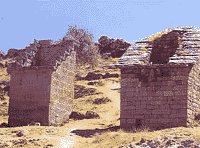 They
consist of a carved chamber with one row of three or four apertures, or
two rows of three apertures by which the birds enter. The chamber measures
from 5 to 10 square metres with four or five rows of niches for the birds
to perch and nest in, and sometimes wooden perches fitted across. Where
the façades have collapsed this interior arrangement is clearly visible.
Even the smallest dovecotes could accommodate over one hundred birds.
They
consist of a carved chamber with one row of three or four apertures, or
two rows of three apertures by which the birds enter. The chamber measures
from 5 to 10 square metres with four or five rows of niches for the birds
to perch and nest in, and sometimes wooden perches fitted across. Where
the façades have collapsed this interior arrangement is clearly visible.
Even the smallest dovecotes could accommodate over one hundred birds.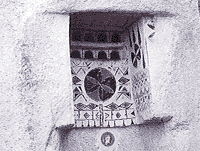 Local
people did not go to the trouble of building dovecotes merely out of
respect for their sacred character however. The dovecotes provided a
source of fertilizer, almost as rich in nitrogen as guano, consisting of
20-25% organic substances, 1-2% nitrogen, and 0.50-1.5% phosphoric acid.
Fertilizer was much needed in this region where farming land was scarce,
so as to obtain maximum harvests from fields, vineyards and orchards. To
collect the accumulated droppings access to the dovecotes was provided by
narrow tunnels carved down from the cliff top or doors reached by ladders
from the valley floor.
Local
people did not go to the trouble of building dovecotes merely out of
respect for their sacred character however. The dovecotes provided a
source of fertilizer, almost as rich in nitrogen as guano, consisting of
20-25% organic substances, 1-2% nitrogen, and 0.50-1.5% phosphoric acid.
Fertilizer was much needed in this region where farming land was scarce,
so as to obtain maximum harvests from fields, vineyards and orchards. To
collect the accumulated droppings access to the dovecotes was provided by
narrow tunnels carved down from the cliff top or doors reached by ladders
from the valley floor.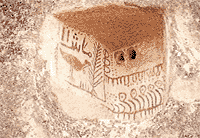 As
well as the motifs described above, some of the dovecotes bear
inscriptions in old Turkish, giving the date, formulas like Maşallah-Allah
(May God protect), or verses from the Koran used to give protection from
the evil eye, and in some rare cases the name and occupation of the owner.
As
well as the motifs described above, some of the dovecotes bear
inscriptions in old Turkish, giving the date, formulas like Maşallah-Allah
(May God protect), or verses from the Koran used to give protection from
the evil eye, and in some rare cases the name and occupation of the owner.