
|
|
|
| Welcome to Turizm.net! |
APHRODISIAS
The wealth and cultural and political importance of the city is clearly attested by the size and magnificence of the buildings of which it is composed.The name Aphrodisias is derived from Aphrodite, the goddess of nature, beauty, love and plenty, and was one of the most famous cult centres of the goddess. But this was not the original name of the city. According to the historian Stephanus it was founded by the Lelegians and was first known as Lelegonopolis.The name of the city was later changed to Megalopolis, and later again to Ninoe after Ninos, the King of Assyria. The history of the city can be traced back to the early bronze age and there is even clear evidence of a chalcolithic culture prior to the 3rd millennium B.C. The use of the name Aphrodisias began after the 3rd century B.C., in the Hellenistic period.The spread of Christianity under the Byzantine Empire and the gradual adoption of Christianity as the state religion resulted in a marked change in the status of the city. The cult centre of Aphrodite declined in importance, to such an extent that the names Aphrodite and Aphrodisias were finally erased from all the inscriptions. Efforts were made to change the name of the city to Stavrapolis, the City of the Cross, but the local inhabitants preferred to use Caria, the name of the province. Geyre, the name of the modern village occupying the same site, is probably a corruption of the ancient Caria, which occurred after the Turkish occupation of the area. It seems very likely that in Turkish, Caria was first pronounced Kayra, and that the "k" then changed to "g" and the "a" to "e'. Like several other Roman and Byzantine cities, Aphrodisias was very largely self sufficient.
The decline of the city was hastened by an unfortunate incident that took place in the 7th century. The reign of the Emperor Heraclius (610-641 ) was marked by Arab raids and incursions from the East, religious disputes, political and economic pressures and a number of epidemics causing great loss of life, but the final stroke was dealt by a devastating earthquake. The damage caused to the buildings by this earthquake is still plainly visible. Some of the most imposing buildings were destroyed and remained unrepaired. Very little is known of the history of the city after the 7th century, sources of information being confined to a few religious documents and lists of the names of the bishops. Archaeological finds, however, would appear to point to a short lived revival in the 11th century. The incursion of the Seljuk Turks from Anatolia
between the 11 Th. and 13th century. The Ruins, the City Defense Walls and City Plan The first thing you see on approaching Aphrodisias from the direction of Karacasu will be the city walls with the Ionic columns of the temple of Aphrodite in the background. The ancient city is locate on a level piece of ground inclining slightly towards the south-west. The construction of the walls is thought to have
been begun during the Gothic invasion in 260, but the walls to he seen today date from the
4th century or later. No trace has been found of any defense system of an older date, but
there may well have been a wall around the acropolis in the area between the agora and the
theatre. The remains found here indicate the existence of a settlement in prehistoric times with seven separate layers identified as belonging to the bronze and iron ages. Traces have been found here of mudbrick walls on stone foundations and architectural structures reminiscent of megaron type houses. Here too were found fairly large jars known as pithoi used for the storage of wheat and other provisions as well as a considerable amount of pottery fragments. The finds also include a number of stone implements, stone statuettes, figures with the faces of owls and fat female idols as well as various weight-measuring instruments. The excavation area known as Pekmez H�y�k to the east of the acropolis yielded pottery of the late neolithic, late chalcolithic and early bronze ages, together with two Kilia figurines.In the Late Hellenistic period the city developed more particularly in the area surrounding the agora. There is no question, however, of any genuine town planning. Neither the Temple of Aphrodite nor the Sebastion conforms to any regular city plan. The Temple of Aphrodite
Tetrapylon
Odeon and Bishop's Palace The odeon, a building which differed from the theatre in being used mainly as a concert hall and lecture room, is in a fairly good state of preservation.Located immediately to the south of the temple, it was constructed in the 2nd century A.D. There were originally a larger number of tiers in the upper part of the buildings but these are thought to have been destroyed in an earthquake.The orchestra and stage building of the odeon were adorned with mosaics an statues now preserved in the museum and the auditorium was covered with a wooden roof. A fairly large architectural complex is to be found to the west of the odeon. Constructed in the Late Roman period, part of this building is thought to have later been used in the Byzantine period as the residence of a governor or bishop. It would thus appear that the temple and its environs preserved its status as a religious and administrative centre into Christian times. Agora The agora, located between the temple and the acropolis was planned in the 1 St. century B.C. for use as a market and popular meeting place. It is composed of two Ionic porticoes over 200 m long and running from east to west. The southern portico, which is known as the portico of Tiberius, was systematically examined in the course of the older excavations, while the 1937 excavations carried out by the Italian team yielded extremely valuable friezes together with inscriptions written in praise of the Emperor Tiberius.Recent excavations conducted in the northern section, in the western section near the baths of Hadrian and the gate of the agora in the south-east yielded a large number of very fine specimens of the skill of the Aphrodisian sculptors and stone-carvers. Most of the reliefs consist of sacred or individual portraits surrounded by wreaths or garlands, masks and mythological scenes.The monumental gate of the agora is located at the eastern end of the Portico of Tiberius. This ornamental entrance was erected in the middle of the 2nd century but in order to prevent the flooding that followed the 4th century earthquake it was converted into a nymphaeum and connected to a water supply system to be used in controlling the water flow. This is thought to have been constructed in the 5th century and to have suffered severe damage in the 7th century earthquake. Among the scenes represented on the reliefs in the niches on the Agora gate are to be seen the struggle between the Centaurs and the Lapiths (Centauromachy), between the Gods and the Giants (Gigantomachy) and between the Amazons and the Greeks (Amazonomachy). Baths of Hadrian The baths constructed in the 2nd century during the reign of the Emperor Hadrian lie to the west of the Portico of Tiberius. This complex consists of a large central hall, probably the caldarium or hot room, surrounded. by four large rooms, the tepidarium, s��datorium, apoditerium and frigidarium (warm room, sweating room, dressing room and cold room respectively). It is a most imposing building with all the requisite facilities, such as labyrinthine underground service corridors, water channels and furnaces. In the excavations conducted here in 1904 the French archaeologist Paul Gaudin unearthed a large number of artistic works now preserved in the Istanbul Archaeological Museum. Theatre Begun in 1966, the excavations in the theatre area yielded a great deal of extremely valuable information regarding both the prehistoric and historic periods in Aphrodisias as well as very well preserved sections of the theatre building and a large number of statues and reliefs of the highest quality. The theatre building rests against the eastern slope of the acropolis. Construction was completed in 27 B.C. but in the 2nd century A.D. certain structural changes were made to make the theatre suitable for gladiatorial combats. The stage building was enlarged and connected to the cavea, a room for the wild animals was opened in the rear and some corridors were added. Following the collapse of the upper sections of the cavea in the 7th century earthquake and the partial filling up of the auditorium the Byzantine inhabitants covered the orchestra and stage buildings with earth and built houses over it, at the same time surrounding the acropolis with a wall.The most interesting and remarkable of the finds discovered in the excavations was the Zoilos relief. Zoilos was a manumitted slave of Octavian who played an influential role in fostering good relations between Aphrodisias and Rome and who succeeded in having the city exempted from tax. The proscenion and logeion sections of the theatre were presented by Zoilos as a gift to Aphrodite and the citizens of Aphrodisias. Sebastion The Sebastion is a most remarkable discovery, not only as regards the excavations in Aphrodisias but in the whole context of classical archaeological excavation. When the building was first unearthed in 1979 it appeared to have no relation to any other building but, as excavations were carried down to deeper levels, it became apparent that this consisted of a temple dedicated to the cult of the Emperor Augustus (Sebastos is the Greek equivalent of the Latin Augustus) and its surrounding complex. Of the temple only the foundations now remain,
together with a few column bases, Corinthian style capitals and architrave blocks. In
addition to the damage inflicted by the earthquakes in the 4th and 7th centuries, the
remains of the temple also suffered from the use of the area for settlement in the
Byzantine and Turkish periods. There are also a number of fragments depicting the peoples of the various countries with which Augustus had waged war or formed other types of relationships but these have suffered severe earthquake damage. It would appear from the epigraphic evidence that the Sebastion porticoes were built during the reigns of Claudius and Nero and were the gifts of two separate families. Stadium
These competitions in the province of Asia Minor were modeled on the Olympic and Pythian games in Greece, and had the same name and organization as the Greek equivalent. These shows were held with the permission of Rome and the granting of such permission was regarded as a signal honour. The games held in Aphrodisias were Pythian, not Olympic. These were complemented by the Gordineia festivals held in honour of the Emperor and with his special permission. The Museum of Aphrodisias The Museum of Aphrodisias is one of the most outstanding museums of western Anatolia. The monuments of unsurpassed value which have been found at the excavations are displayed here.
Places To Visit: Related Links: Photographs by:Semsi Guner,Erdal Yazici,Gungor Ozsoy,Haluk Ozozlu,Firdevs Sayilan,Donence Diabank |
|
|
Home |
Turkey I
Cities & Sites
I Hotels I
Blue Cruise
I Tours I
Contact Us |
Search I
Ask for a quote to compare:
Cruises I
Biblical Tours I
Incentive Travel I
Hotels I
Transfers
Copyright � 1995-2016 Turizm.net
All rights reserved.
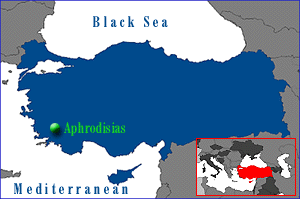 The ancient city of Aphrodisias, once the capital of the province of Lydia, is
located near the village of Geyre in the district of Karacasu 38 km south of Nazilli.In
ancient times, the attractive marble buildings of Aphrodisias no doubt shone out, as they
do now, from amidst the rich vegetation of the Dandalaz valley with its almond,
pomegranate and poplar trees.
The ancient city of Aphrodisias, once the capital of the province of Lydia, is
located near the village of Geyre in the district of Karacasu 38 km south of Nazilli.In
ancient times, the attractive marble buildings of Aphrodisias no doubt shone out, as they
do now, from amidst the rich vegetation of the Dandalaz valley with its almond,
pomegranate and poplar trees.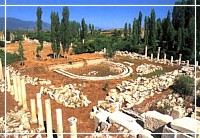 Aphrodisias
was one of the foremost cities of the age, surrounded by fertile fields producing every
type of foodstuff. It also possessed a flourishing wool and cotton industry, highly
developed commercial, political, religious and cultural institutions ,very fine tradition
of arts and crafts, world-famous schools of philosophy and sculpture and a large and
energetic body of citizens.
Aphrodisias
was one of the foremost cities of the age, surrounded by fertile fields producing every
type of foodstuff. It also possessed a flourishing wool and cotton industry, highly
developed commercial, political, religious and cultural institutions ,very fine tradition
of arts and crafts, world-famous schools of philosophy and sculpture and a large and
energetic body of citizens.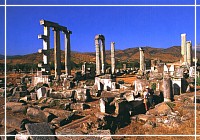 Located in the northern section, in ancient times the Temple of Aphrodite formed
the centre and nucleus of the city. All that remains of the ancient temple consists of
fourteen of the over forty Ionic columns that once surrounded it and the foundations of
the cella section. Although the cult centre dates back to earlier times the temple whose
remains we see today was begun in the 1st century B.C. and is thought to have been
completed during the reign of Augustus. The temenos (temple precinct) was completed in the
2nd century during the reign of Hadrian. The building would appear to have been what is
known as an octastyle temple with thirteen columns on each side and eight columns at front
and rear. On some of the columns are inscribed the names of the donors who presented them
to the temple. The discovery of several mosaic fragments belonging to the Hellenistic
period indicate the existence of an older temple on the same site, but with the conversion
of the temple to a church in the 5th century all traces of the older building were erased.
At the same time, the walls of the cella containing the cult statues were removed and the
building enlarged by moving the side columns outwards. Walls were added at the front and
rear of the building to form an apse and nave. An apse and an atrium were added on the
east and west. No cult statue was found in the cella but in 1962 a statue was found
immediately outside it bearing all the characteristics of a cult statue. This statue,
which is now exhibited in the museum, displays a stiff, hieratic stance closely resembling
the Artemis of
Located in the northern section, in ancient times the Temple of Aphrodite formed
the centre and nucleus of the city. All that remains of the ancient temple consists of
fourteen of the over forty Ionic columns that once surrounded it and the foundations of
the cella section. Although the cult centre dates back to earlier times the temple whose
remains we see today was begun in the 1st century B.C. and is thought to have been
completed during the reign of Augustus. The temenos (temple precinct) was completed in the
2nd century during the reign of Hadrian. The building would appear to have been what is
known as an octastyle temple with thirteen columns on each side and eight columns at front
and rear. On some of the columns are inscribed the names of the donors who presented them
to the temple. The discovery of several mosaic fragments belonging to the Hellenistic
period indicate the existence of an older temple on the same site, but with the conversion
of the temple to a church in the 5th century all traces of the older building were erased.
At the same time, the walls of the cella containing the cult statues were removed and the
building enlarged by moving the side columns outwards. Walls were added at the front and
rear of the building to form an apse and nave. An apse and an atrium were added on the
east and west. No cult statue was found in the cella but in 1962 a statue was found
immediately outside it bearing all the characteristics of a cult statue. This statue,
which is now exhibited in the museum, displays a stiff, hieratic stance closely resembling
the Artemis of 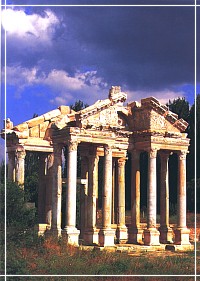 One
of the most attractive features of Aphrodisias is the ornamental gate constructed in the
middle of the 2nd century. The name Tetrapylon refers to its being composed of four groups
of four columns. The entrance lies to the east. The front row of Corinthian columns with
spiral fluting look out on to a street with north-south alignment. The second and third
columns of this fourfold structure are surmounted by a semicircular lintel with relief
figures of Nike and Erotes amid acanthus leaves. The process of repairing and re-erecting
the Tetrapylon columns was completed in 1990.
One
of the most attractive features of Aphrodisias is the ornamental gate constructed in the
middle of the 2nd century. The name Tetrapylon refers to its being composed of four groups
of four columns. The entrance lies to the east. The front row of Corinthian columns with
spiral fluting look out on to a street with north-south alignment. The second and third
columns of this fourfold structure are surmounted by a semicircular lintel with relief
figures of Nike and Erotes amid acanthus leaves. The process of repairing and re-erecting
the Tetrapylon columns was completed in 1990.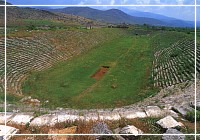 The
Aphrodisias stadium is the best preserved of all the ancient stadiums in the Mediterranean
region. Located in the northern section of the city it is 262 m in length and 59 m wide
with a seating capacity of 30,000. The ends of the stadium
The
Aphrodisias stadium is the best preserved of all the ancient stadiums in the Mediterranean
region. Located in the northern section of the city it is 262 m in length and 59 m wide
with a seating capacity of 30,000. The ends of the stadium